
A Story That Challenges Its Own Ending
On Radha, Krishna, and the curious philosophy of separation and unity.
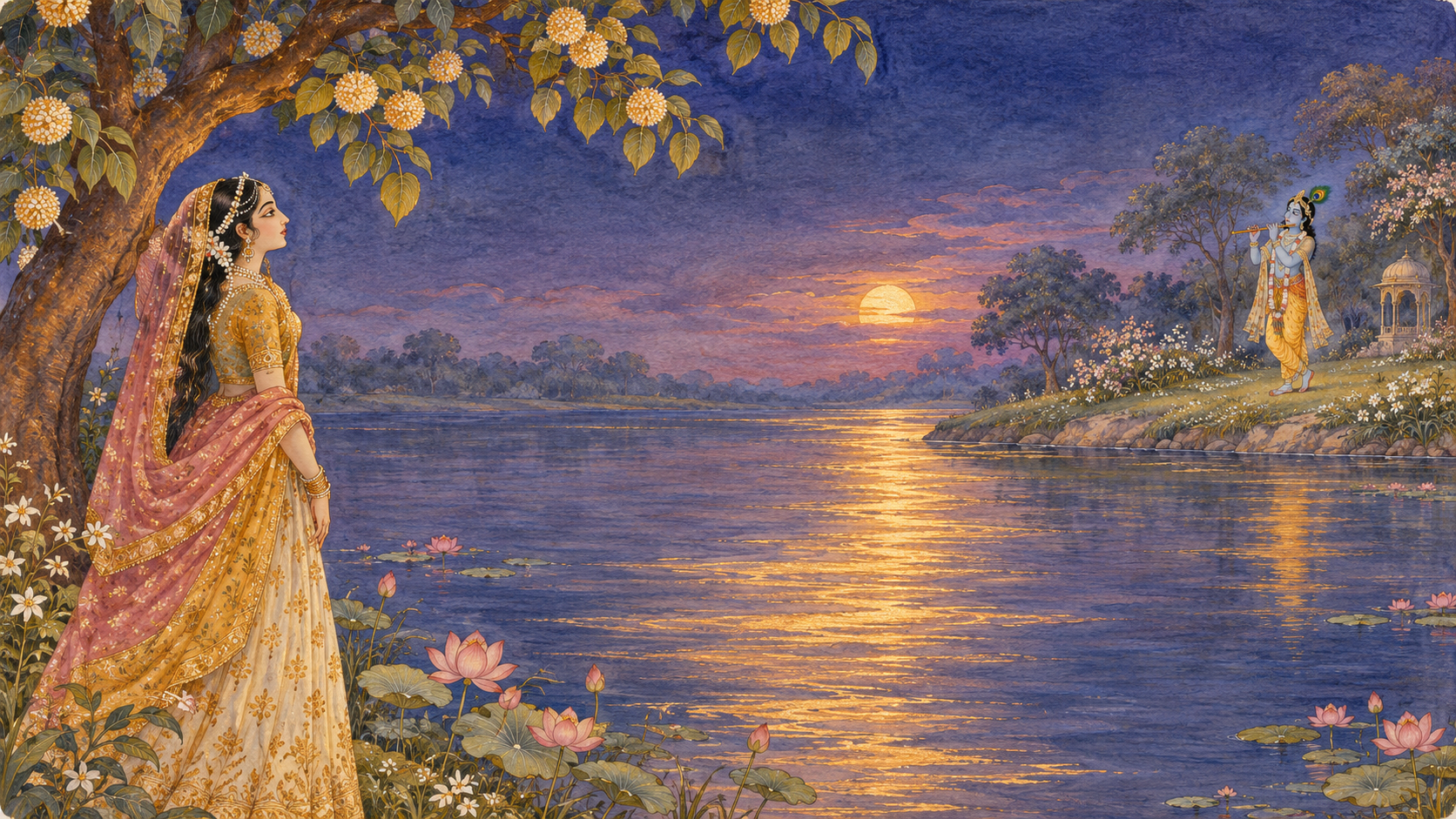
I recently came across a retelling of Radha and Krishna’s story, and one particular aspect of it stayed with me.
We almost always hear their names together. Radhe Krishna. Yet, in the version of the story most of us are familiar with, they never married. Krishna leaves Vrindavan for Mathura, defeats Kansa, and eventually settles in Dwarka, where his life takes a very different direction.
Radha remains associated with Vrindavan.
And yet, their names remain inseparable.
What I found fascinating was not the separation itself, but the contradiction it seems to create. How did a story in which two figures follow different paths become such an enduring symbol of unity?
The more I explored the idea, the more interesting it became. Their story raises questions about identity, presence, absence, and whether an ending necessarily determines the meaning of everything that came before it.
The Different Worlds of Krishna
Krishna’s life is interesting because of the many different roles he occupies.
In Vrindavan, he is the playful cowherd, the flute player, and the center of the gopis’ affection.
In Mathura, he confronts Kansa.
In Dwarka, he becomes a leader and a householder.
And in the Mahabharata, he becomes a strategist, a guide, and the philosopher who delivers the Bhagavad Gita.
Radha, however, remains associated with Vrindavan.
That distinction is interesting because Vrindavan represents Krishna before the responsibilities and authority of his later life.
His connection with Radha belongs to a world where his identity is not defined by kingship, political responsibility, or philosophical teachings.
It raises an interesting question: how much of someone’s identity comes from who they are, and how much comes from the roles they eventually assume?
The different stages of Krishna’s life seem to offer different ways of understanding the same person.
When Absence Becomes Presence
One concept I encountered while exploring this story was viraha, which refers to separation or longing.
What makes it interesting is the idea that physical absence and continued presence in consciousness are not necessarily opposites.
In the familiar narrative, Krishna’s departure does not erase his significance in Radha’s world. Instead, separation becomes central to how their relationship is remembered.
The philosophical question is whether something must remain physically present to continue being meaningful.
Viraha offers an unusual perspective. It suggests that separation can transform an experience rather than simply bring it to an end.
In devotional interpretations of Radha and Krishna, longing itself becomes a form of devotion.
This is a very different way of understanding absence. Rather than treating it as the opposite of connection, the story explores how the two can coexist.
Separate, Yet Inseparable
Perhaps the most intriguing part is that Radha and Krishna are often described as spiritually inseparable, even though many accounts portray them as physically separated.
At first, this sounds contradictory.
But perhaps the contradiction exists only because we tend to equate unity with togetherness.
Physical proximity is one kind of connection. Spiritual unity is a different concept altogether.
In devotional interpretations, Radha and Krishna’s unity is understood as something that does not depend on their earthly circumstances.
Their separation, therefore, does not necessarily contradict their inseparability.
Instead, the two ideas exist at different levels of the story.
What appears to be separation in the narrative becomes an expression of unity in its philosophical interpretation.
Why Does Radha Remain So Central?
Krishna’s life extends far beyond Vrindavan.
His role in the Mahabharata, his teachings in the Bhagavad Gita, and his association with the restoration of dharma are central to how he is understood.
Yet Radha remains inseparable from his name in many devotional traditions.
What makes this particularly interesting is that Radha represents a different way of approaching Krishna.
The Bhagavad Gita presents Krishna as a teacher of duty, action, knowledge, and spiritual understanding.
The stories of Vrindavan emphasize devotion and personal connection.
These are different dimensions of the same figure.
One is concerned with understanding the Divine through wisdom and action. The other approaches the Divine through devotion.
Radha’s significance lies in how completely she represents that devotional dimension.
Does the Story Really Have an Ending?
Another interesting detail is that there isn’t one universally accepted version of Radha and Krishna’s story.
Some traditions emphasize their separation. Others describe them as eternally united, and some accounts even speak of a divine marriage.
So the familiar idea that their story ended with Krishna’s departure is itself only one way of understanding it.
This makes the question of an ending more complicated.
Perhaps the enduring significance of Radha and Krishna comes partly from the fact that their story has never been confined to a single conclusion.
Different interpretations explore different aspects of the same relationship, and each adds another dimension to its meaning.
A Story That Challenges Its Own Ending
What began as an interesting detail in a familiar story turned into a much broader philosophical question for me.
Why do we assume that separation and unity must be opposites?
Why do we expect the conclusion of a story to determine its significance?
And can something remain meaningful independently of whether it continues in the form we originally expected?
The story of Radha and Krishna offers an interesting way to approach these questions.
Its philosophical interpretations distinguish physical presence from spiritual unity, and an earthly narrative from the meaning attached to it.
Perhaps that is what makes the story so enduring.
Radha and Krishna’s separation does not simply mark the end of their story. It becomes part of the reason their unity continues to be explored.
And perhaps the most fascinating thing about the story is that it doesn’t resolve the apparent contradiction between separation and unity.
It challenges the assumption that they were ever necessarily opposites.