
The Paradox of Becoming
I have spent a good part of my life trying to optimize things. Work can be optimized, code can be optimized, models can be optimized. You define an objective, measure where you are, understand the error, and iterate.
Somewhere along the way, perhaps without realizing it, I started applying the same philosophy to myself: be more disciplined, think more rationally, become independent, work harder, remove distractions, make better decisions and keep moving.
The problem is that human beings are terrible optimization problems.
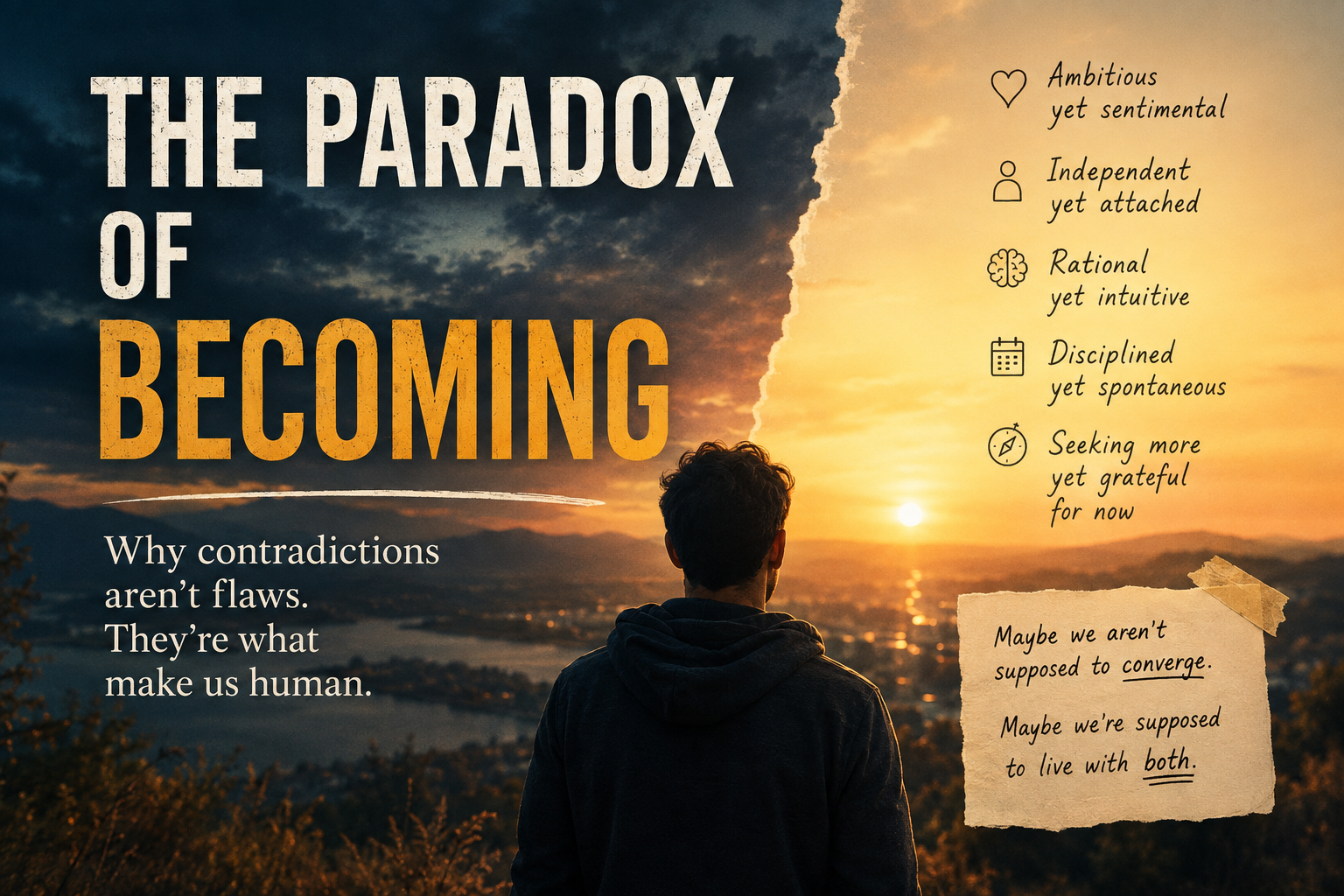
The more I have tried to understand myself, the more contradictions I have found. I am intensely ambitious, yet surprisingly sentimental. I can be extremely rational while solving a problem and still trust intuition when it comes to people. I value independence enormously, yet become deeply attached to a very small number of people. I can follow routines with almost mechanical discipline and still occasionally want to throw the plan away. I can be confident among people while keeping large parts of myself private.
For a long time, I thought maturity meant resolving these contradictions.
Increasingly, I think maturity might mean learning to live with them.
Life Is a Multi-Objective Problem
In machine learning, optimization gets considerably harder when there are multiple objectives. A system may need to maximize accuracy while minimizing latency, memory and cost. There is rarely a configuration that simultaneously maximizes everything. Improving one dimension often comes at the expense of another.
Life seems suspiciously similar.
We want achievement, but also peace. Freedom, but also belonging. Discipline, but also adventure. Independence, but also intimacy. Growth, but also stability.
We spend years trying to find the magical configuration where we can maximize all of them, only to discover that such a point probably doesn’t exist.
In multi-objective optimization, there is the idea of a Pareto frontier: solutions where improving one objective requires sacrificing something elsewhere.
Perhaps people have Pareto frontiers too.
A good life may not be one in which every dimension has been maximized, but one in which we have consciously chosen the trade-offs we are willing to live with.
That thought has made my contradictions feel less like defects and more like competing objectives.
Ambitious Enough to Leave, Sentimental Enough to Remember
Ambition is naturally forward-looking. There is always another mountain, another problem, another version of yourself that doesn’t exist yet. The moment something is achieved, the mind starts wondering what comes next.
Sentimentality moves in the opposite direction.
It makes us look backward at places we once lived, people we once knew, conversations nobody else remembers and versions of ourselves that disappeared quietly while we were busy becoming someone else.
The strange thing is that the rational mind can understand perfectly well that a chapter has ended while the emotional mind continues carrying pieces of it. Knowing that something is over doesn’t automatically make it meaningless, nor does moving forward require pretending that nothing behind us mattered.
Perhaps sentimentality is actually a useful counterweight to ambition.
Without it, life can become an endless sequence of objectives: achieve something, enjoy it briefly, replace it with something harder. We become very good at reaching destinations and very bad at inhabiting them.
Some moments weren’t valuable because they moved us closer to a goal.
They were valuable simply because we were there.
Independence Doesn’t Mean Detachment
Independence has always appealed to me. There is something satisfying about knowing that you can enter uncertainty and figure things out yourself. Depending less on external validation gives you enormous freedom.
But independence doesn’t make attachment disappear.
In some ways, it may make attachment more intense. When you don’t let many people deeply into your life, the few who cross that boundary can matter disproportionately.
And attachment is uncomfortable for someone who likes control because it introduces variables that cannot be optimized.
I can control how hard I work, whether I show up and what I choose to build. I cannot completely control whether someone stays, whether feelings change, whether circumstances intervene or whether two lives continue moving in the same direction.
No amount of intelligence solves that uncertainty.
Maybe this is one of the things relationships teach that achievement cannot:
Some of the most meaningful things in life refuse to become controllable.
Discipline Needs a Little Chaos
There is another technical idea I increasingly find useful: the exploration-exploitation trade-off.
A learning system can exploit what it already knows works, or it can explore uncertain alternatives that might lead somewhere better. Too much exploration and it never settles. Too much exploitation and it becomes trapped by its existing knowledge.
Discipline is life’s exploitation strategy.
Wake up, train, work, read, build, repeat.
Most meaningful achievements are probably much more boring in their construction than they appear afterward. Consistency compounds precisely because it isn’t exciting.
But a life optimized entirely around known rewards can become strangely narrow.
Some of the memories that survive for years come from interruptions to the routine: an unexpected journey, a conversation that went on much longer than intended, a decision that looked inefficient on paper.
Discipline gives life direction.
Spontaneity gives it texture.
Perhaps the goal isn’t choosing between them, but knowing when each one has earned control.
The Problem With Local Minima
Optimization offers one more metaphor that I particularly like: the local minimum.
A system can settle into a point that looks optimal because every nearby direction initially appears worse, even though something much better may exist beyond the surrounding landscape.
Escaping requires energy. Sometimes noise. Sometimes momentum.
Life has local minima everywhere.
A comfortable job can become one. A familiar routine can become one. Even an identity can become one. We can become so comfortable with our current understanding of ourselves that every alternative initially feels wrong.
Sometimes failure supplies the disturbance required to escape. Sometimes ambition does. Sometimes curiosity does. Occasionally another person enters your life and changes the landscape completely.
But human life adds a complication that optimization doesn’t have:
Not every minimum needs escaping.
Some forms of stability aren’t stagnation. Some things are worth staying for.
There is wisdom not only in having enough momentum to leave a comfortable basin, but also in recognizing when the endless search for a better one has become its own trap.
Maybe We Aren’t Supposed to Converge
There is an implicit destination hidden inside much of self-improvement.
Become disciplined. Become confident. Become rational. Become independent. Become successful.
It is as though somewhere in parameter space there exists an ideal configuration called you, and enough optimization will eventually make you converge to it.
I don’t think I believe that anymore.
I don’t want ambition to eliminate sentimentality. I don’t want rationality to eliminate intuition, independence to eliminate attachment, or discipline to eliminate spontaneity.
Those opposing forces create friction, and sometimes that friction makes life harder than it needs to be. But removing either side would remove something valuable too.
Perhaps maturity isn’t the elimination of contradiction.
Perhaps it is learning which part of ourselves should have the steering wheel in a particular situation while allowing the other parts to remain in the car.
There are moments when ambition should win and moments when staying matters more. There are problems that deserve ruthless reasoning and experiences for which reasoning alone is insufficient. There are years when following the plan changes your life and days when abandoning it does.
I used to think becoming better meant converging: pick a direction, reduce the noise, eliminate contradictions and keep optimizing until the person you are approaches the person you want to become.
I’m less convinced now.
Maybe we are supposed to remain slightly unresolved: ambitious enough to leave but sentimental enough to remember, independent enough to walk alone but attached enough to value who walks beside us, rational enough to understand reality but emotional enough to actually experience it.
Perhaps the contradictions aren’t bugs in the system.
Perhaps they are the system.